As the meat processing industry increasingly focuses on healthier formulations, chilled products, and ready-to-cook or ready-to-eat solutions, the market for specialized food ingredients is evolving.
The growing demand for clean label formulations and fermentation-derived ingredients is creating opportunities for suppliers of natural preservation solutions, acidity regulators, and functional compound ingredients. Compared with conventional high-temperature processed meat products, chilled and further-processed meat products often require more sophisticated formulation strategies to manage microbial stability, texture, color, flavor, and shelf life.
Consequently, ingredient innovation is increasingly focused on fermentation-based preservation systems and application-specific ingredient blends that help manufacturers address multiple formulation challenges.
For ingredient suppliers, this shift creates opportunities to move beyond conventional acidulants and general-purpose additives toward higher-value, application-oriented solutions.
The meat ingredient market is becoming increasingly differentiated. General-purpose acidulants and standard compound additives face intense price competition, while fermentation-derived ingredients and clean label formulation solutions require more specialized technical knowledge.
Manufacturers of chilled meat products and prepared meat foods increasingly need ingredients that can support microbial control without compromising salt reduction goals, water retention, color stability, or the characteristic flavor of meat.
Henan Weichuang Bio-tech Co., Ltd. focuses on grain fermentation technology and the development of fermentation-derived ingredients. Its product portfolio includes buffered vinegar powder, cultured sugar, and high-acidity brewed vinegar.
These ingredients can be evaluated for applications such as chilled ham, bacon, prepared sausages, and other processed meat products. Their suitability depends on the specific formulation, processing conditions, target microorganisms, packaging system, and storage requirements.
Three important developments in downstream meat processing are influencing ingredient innovation:
Growth in chilled meat products: Pasteurization and high-pressure processing (HPP) are used in selected applications, increasing the need to evaluate ingredient performance under specific processing and storage conditions.
Rising interest in clean label formulations: Manufacturers are reviewing ingredient declarations and exploring ways to simplify formulations while maintaining food safety and product quality.
Expansion of foodservice and rapid-delivery channels: Longer distribution chains and changing temperature conditions create additional challenges for shelf-life management.
Ingredient suppliers are therefore increasingly expected to provide more than raw materials. Formulation assessment, ingredient selection, process optimization, and application testing are becoming important parts of the supplier–manufacturer relationship.

Clean label development is becoming an important consideration for premium meat products. Manufacturers are exploring ingredient systems that support simpler formulations while meeting food safety, sensory, and shelf-life requirements.
Weichuang Bio-tech has participated in the development of industry standards related to clean label foods and meat products, including the group standards General Requirements for Clean Label Foods and General Requirements for Clean Label Meat Products. The company has also participated in drafting work related to the identification of brewed vinegar and synthetic acetic acid.
These initiatives reflect the industry’s broader interest in clearer ingredient definitions, manufacturing practices, and raw material authenticity.
Through fermentation-derived ingredients such as cultured sugar and buffered vinegar powder, Weichuang Bio-tech aims to support food manufacturers evaluating clean label formulation options across meat processing and bakery applications.
Reducing salt, fat, and externally added synthetic additives is an important formulation objective for many meat manufacturers. However, reducing salt may also affect microbial stability, texture, and water retention, making formulation changes technically challenging.
Fermentation-derived ingredients, including buffered vinegar powder, can be evaluated as part of a broader preservation strategy. Depending on the product formulation and application conditions, they may help support microbial control and delay certain spoilage processes.
Potential applications include processed meat products, compound sauces, pickled vegetables, and bakery products.
Performance should be verified through product-specific trials that consider pH, water activity, salt concentration, processing conditions, packaging integrity, and storage temperature. No ingredient can independently compensate for inadequate hygiene, processing controls, or cold-chain management.
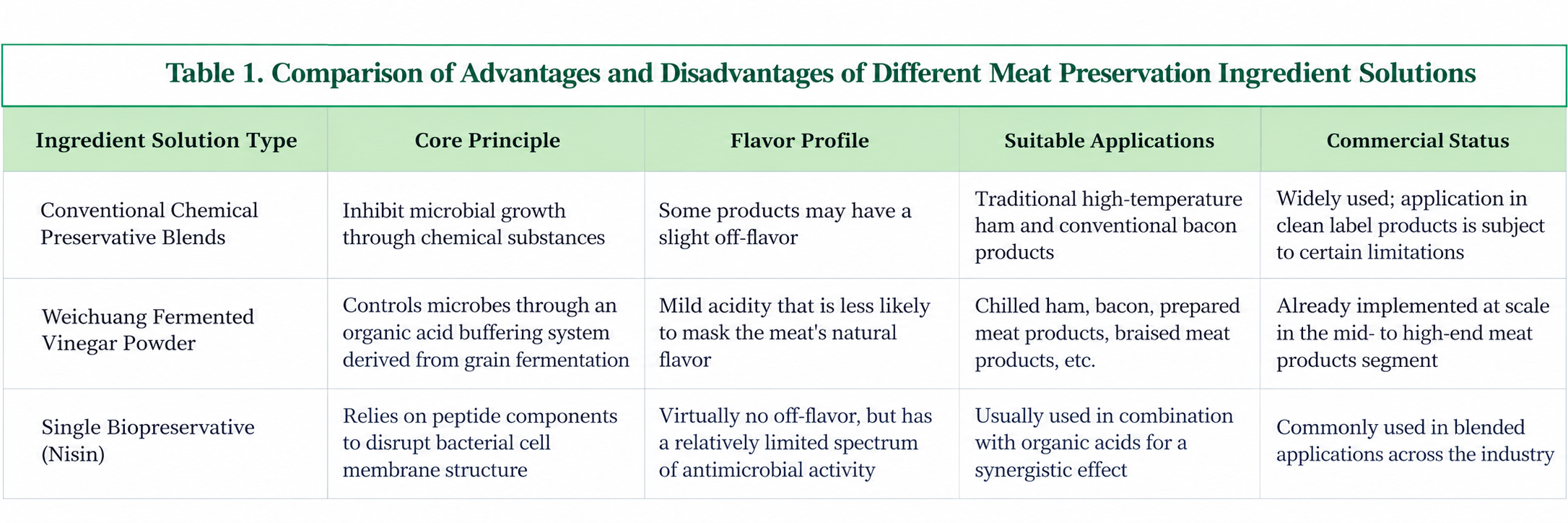
Conventional preservatives can provide effective microbial control, but some manufacturers are exploring alternative ingredient systems to meet particular clean label objectives.
Potential approaches include fermentation-derived ingredients, buffered vinegar systems, and other suitable antimicrobial ingredients. Depending on the target product, formulations may also incorporate ingredients such as nisin or ε-polylysine, where permitted by applicable regulations.
Weichuang Bio-tech develops ingredient solutions based on brewed grain vinegar and fermentation technology. These ingredients can be assessed for use in selected cooked meat products, chilled meat products, and ready-to-eat sausages.
The objective is to identify an appropriate balance between microbial stability, flavor, texture, ingredient declaration, regulatory compliance, and cost. Ingredient selection and labeling must be evaluated according to the relevant market’s food regulations.
The development of differentiated meat products is creating demand for more tailored formulation strategies. Examples include fermented sausages, tender-texture meat products for older consumers, high-protein meat snacks, and meat-based complementary foods.
Each category has different requirements for acidity, microbial stability, flavor, texture, and ingredient declaration.
Application-specific ingredient development may help manufacturers address these needs. For example:
Tender-texture meat products: Formulations may prioritize a mild flavor profile and suitable texture.
High-protein meat snacks: Water retention, texture stability, and restrained acidity may be key considerations.
Meat-based complementary foods: Ingredient suitability, food safety, sensory characteristics, and applicable requirements for the intended age group need particular attention.
For smaller manufacturers, targeted product development can create differentiation beyond price competition in mainstream meat products.
Chilled processed meat products are valued for their characteristic flavor and texture. However, their shelf life can be challenging to manage because microbial growth is affected by formulation, heat treatment, post-process contamination, packaging, and storage temperature.
Ingredient systems can contribute to a preservation strategy, but they must be designed around the complete manufacturing and distribution process.
As chilled meat products enter broader distribution channels, manufacturers need to evaluate whether ingredient systems remain effective without introducing excessive acidity or undesirable flavor changes.
Conventional vinegar may contribute a pronounced acidic taste when used at unsuitable levels. Buffered vinegar systems can offer an alternative approach to managing acidity and sensory impact, depending on the product formulation.
Weichuang Bio-tech’s high-acidity brewed vinegar and buffered vinegar powder can be evaluated for selected chilled ham, bacon, sausage, and prepared meat applications.
These ingredients may be considered alongside pasteurization, vacuum packaging, high-barrier packaging, or modified-atmosphere packaging, where appropriate. The final shelf-life outcome depends on the combined effects of formulation, processing, packaging, hygiene, and temperature control.
Application testing is essential to establish suitable use levels and confirm product quality throughout the intended storage period.
1. Rapid-delivery and online retail
Temperature fluctuations during transportation can increase the risk of microbial growth in chilled foods. Manufacturers should evaluate preservation performance under realistic distribution and storage scenarios while maintaining appropriate temperature controls.
2. Foodservice supply chains
Restaurant chains and catering suppliers require consistent product quality across large production batches. Ingredient systems should be compatible with industrial processing, repeatable dosing, and established production procedures.
3. Regional and community distribution
Where cold-chain infrastructure is less consistent, manufacturers need robust food safety management and packaging systems. Ingredient selection should be part of a validated preservation strategy rather than a substitute for reliable temperature control.
Meat processors increasingly require consistent ingredient quality, batch-to-batch reproducibility, traceability, and straightforward integration into existing production lines.
Weichuang Bio-tech focuses on production control, practical ingredient formulation, and traceable quality management to support these requirements.
With experience in grain fermentation, Weichuang Bio-tech uses selected fermentation cultures and established process controls to produce high-acidity brewed vinegar.
The company operates liquid fermentation, solid-state fermentation, and finished-product filling facilities, supported by laboratory testing equipment and quality inspection procedures.
These production capabilities help support consistent product specifications and provide a foundation for application development.
Different meat products present different challenges, from chilled ham and bacon to prepared sausages and braised meat products.
Weichuang Bio-tech develops practical ingredient solutions intended to help manufacturers evaluate suitable formulations without having to build every ingredient system from scratch.
Depending on the application, these solutions can be assessed for compatibility with existing production lines and standard dosing procedures. Pilot trials are recommended before commercial implementation to confirm performance, sensory acceptance, and cost effectiveness.
Traceability and documented quality controls are essential to food safety management.
Weichuang Bio-tech maintains production and quality records covering relevant manufacturing stages, product inspection, batch identification, and shipment documentation. These records can support customer quality assessments and raw material traceability procedures.
The company emphasizes documented processes, verifiable product information, and practical support for downstream manufacturers.

Despite growing interest in clean label and fermentation-derived ingredients, several challenges remain.
Ingredient performance can vary with product pH, salt concentration, water activity, processing temperature, packaging, and target microorganisms. Manufacturers without dedicated application development teams may require support with formulation trials and process adjustments.
Fermentation-derived ingredients may have a higher purchase cost than some conventional alternatives. Smaller meat processors must therefore assess the overall cost of a formulation, including dosage, production efficiency, product losses, shelf-life performance, and market positioning.
Clean label development is not simply a matter of replacing one ingredient. Changes may affect microbial stability, sensory properties, processing performance, and labeling compliance.
Successful implementation requires coordinated evaluation of ingredients, processing, packaging, hygiene, and storage conditions.

The continued development of chilled meat products and prepared meat foods is likely to sustain interest in fermentation-derived ingredients and clean label formulation strategies.
For ingredient suppliers, competitive advantage will increasingly depend on the combination of reliable raw materials, fermentation process expertise, standardized quality, and application support.
For meat processors, ingredient procurement is evolving toward a more collaborative model that combines raw material supply with formulation guidance and technical evaluation.
1. Develop a phased clean label strategy
Review existing formulations and identify opportunities to optimize selected ingredients. Evaluate suitable fermentation-derived alternatives through laboratory and pilot-scale trials, balancing microbial control, sensory quality, regulatory requirements, and cost.
2. Coordinate ingredients, processing, and packaging
Natural ingredients should not be treated as standalone preservation solutions. Formulation changes need to be evaluated alongside pasteurization or other validated processing methods, packaging selection, sanitation, and cold-chain management.
3. Work with suppliers that offer application support
Manufacturers without extensive in-house R&D resources may benefit from working with ingredient suppliers that can assist with formulation assessment, ingredient selection, and process trials. This approach can help reduce trial-and-error costs and improve implementation efficiency.
4. Build differentiation through specialized product categories
Consider developing targeted formulations for high-protein snacks, texture-modified products, prepared foods, and other specific market segments. Tailored ingredient strategies may help manufacturers address distinct consumer and processing needs.
As a food ingredient manufacturer specializing in grain fermentation and fermentation-derived ingredients, Henan Weichuang Bio-tech Co., Ltd. provides solutions for food manufacturers exploring clean label formulation and shelf-life management.
Our product portfolio includes buffered vinegar powder, cultured sugar, high-acidity brewed vinegar, and other food ingredient solutions for selected food applications.
We work with customers to assess ingredient suitability, optimize formulations, and evaluate performance under specific processing and storage conditions.
Looking for ingredient solutions for your meat products? Contact Weichuang Bio-tech to discuss your formulation requirements and explore suitable fermentation-derived ingredients for your application.

The original Chinese article identifies the following materials as potential references for industry background and technical context:
China Meat Association, 2025 White Paper on the Development of China’s Meat Processing Industry.
Public reporting by Xinhua News Agency on the 2025 Meat Industry Innovation and Development Conference.
T/CMATB 9013-2023, Clean Label Meat Products — General Requirements.
Public industry perspectives from the annual meeting of the National Meat Processing Industry Science and Technology Innovation Alliance.
Public materials relating to FSSC 22000 and HACCP food safety management systems, together with Weichuang Bio-tech’s technical documentation.
Free
sample

